NOUN Vice-Chancellor Advocates for Assistive Technologies in Education
Integration of Assistive Technologies
The Vice-Chancellor of the National Open University of Nigeria (NOUN), Prof. Uduma Oji Uduma, has called on open and distance learning (ODL) institutions across West Africa to incorporate assistive technologies into their teaching and learner support services. This initiative aims to promote inclusive education for all learners.
Prof. Uduma made this appeal on Tuesday, October 13, 2026, in Abuja during his opening address at a two-day Regional Workshop on Assistive Technologies for Differently-Abled Learners in Open and Distance Learning Institutions, held at the university’s headquarters in Jabi, Abuja. He was represented by the Deputy Vice-Chancellor for Technology, Innovation, and Research, Professor Christine Ofulue.
In his address, Prof. Uduma emphasized that expanding access to education must extend beyond mere enrollment to ensure that learners with disabilities can participate meaningfully, learn with dignity, and fully benefit from educational opportunities. He pointed out that while ODL has improved access for individuals facing barriers to traditional learning, there is a pressing need for institutions to address the specific challenges that learners with disabilities face throughout their academic journeys.
According to Prof. Uduma, assistive technologies can help reduce these barriers and foster independent learning. However, he stressed that technology alone cannot guarantee inclusion without appropriate institutional policies, accessible learning materials, and responsive learner support services.
“Our task, therefore, is not simply to explore available technologies. It is also to consider how our institutions can create a conducive environment in which these technologies will make a meaningful difference to learners’ experiences and outcomes,” he stated.
Prof. Uduma highlighted NOUN’s commitment to inclusive education, which includes the adoption of a policy for learners with special needs, the establishment of a Special Needs Unit under the Directorate of Learner Support Services, and the launch of an interdisciplinary network on inclusive education during a pre-conference workshop at the university’s third ODeLAN Conference in 2024. He acknowledged, however, that more work is necessary and described the workshop as an opportunity for participating institutions to evaluate existing provisions, share experiences, and identify practical strategies for enhancing support for learners with disabilities.
He urged participants to move beyond discussions and technology demonstrations, advocating for the establishment of clear priorities and actionable approaches tailored to their respective institutional contexts.
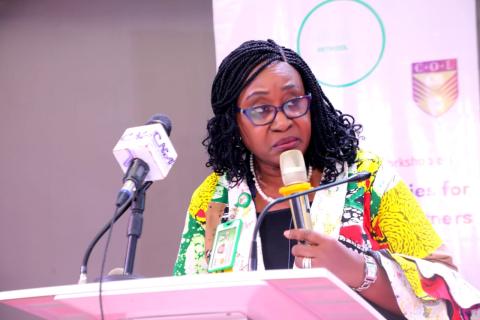
In her opening remarks, Professor Jane-Frances Agbu, Adviser for Higher Education at the Commonwealth of Learning, noted that while open and distance learning has successfully addressed many geographical barriers to education, there remain significant challenges related to inaccessible technologies, learning environments, and educational practices. She described the workshop as a vital opportunity for stakeholders to explore how assistive technologies can enhance accessibility and meaningful engagement for differently-abled learners across West Africa.
Professor Agbu elaborated on various tools such as screen readers, speech-to-text applications, captioning tools, adaptive devices, and accessible digital platforms, stating that these could significantly aid learners in accessing information and participating more independently in their educational pursuits. She emphasized that the success of inclusive education hinges on actively listening to learners with disabilities and involving them in designing solutions that meet their actual needs.
“The true measure of open education is not simply how many learners we reach, but how many we enable to participate meaningfully, learn with dignity, realize their potential, and succeed,” she said. She encouraged participants to utilize the workshop to exchange institutional experiences, identify sustainable solutions, strengthen partnerships, and agree on concrete actions that would translate discussions into tangible improvements in learners’ experiences.
Earlier, Professor Dorothy Ofoha, Director of the Regional Training and Research Institute for Distance and Open Learning (RETRIDOL), welcomed participants and reaffirmed the institute’s commitment to enhancing the capacity of higher education institutions in open and distance learning across West Africa. She explained that RETRIDOL was established in 2003 through a collaboration between NOUN and the Commonwealth of Learning, with a mandate to advance open and distance learning through training, research, and regional cooperation.
Professor Ofoha noted that the institute has supported capacity-building initiatives across countries including Cameroon, Gabon, The Gambia, Ghana, Nigeria, Sierra Leone, and Togo. She emphasized that access to education remains incomplete if learners with disabilities cannot fully engage with learning materials, digital platforms, and assessment activities. The workshop served as a platform for participants to share experiences, examine existing practices, and explore how assistive technologies can be effectively integrated into teaching and learning processes.
She acknowledged the diverse participation of academics, learner support professionals, instructional designers, policymakers, information technology specialists, ODL practitioners, representatives of the National Commission for Persons with Disabilities, and learners themselves as an opportunity to examine inclusion from multiple perspectives. Professor Ofoha expressed gratitude to the NOUN Vice-Chancellor for supporting staff participation in the workshop and to the Commonwealth of Learning for its ongoing partnership with RETRIDOL. She urged participants to ensure that the insights gained during the workshop lead to practical improvements in institutional policies and accessible education across the region.
In his vote of thanks, Prof. Olugbenga Ajadi thanked all participants and wished them fruitful deliberations. The workshop brought together stakeholders from higher education institutions and relevant government and regulatory agencies across West Africa to explore practical approaches to integrating assistive technologies into open and distance learning, thereby strengthening educational opportunities for learners with disabilities.
The workshop featured plenary sessions on Draft Recommendations and validation, as well as designing inclusive learning environments for differently-abled learners in ODL.