If you’re about to register for GST302 or you’ve already seen it on your course list and you’re wondering how it works, you’re definitely not alone. Many students find this course confusing at first because it doesn’t follow the usual structure of other courses. But once you understand the process, everything becomes much easier.
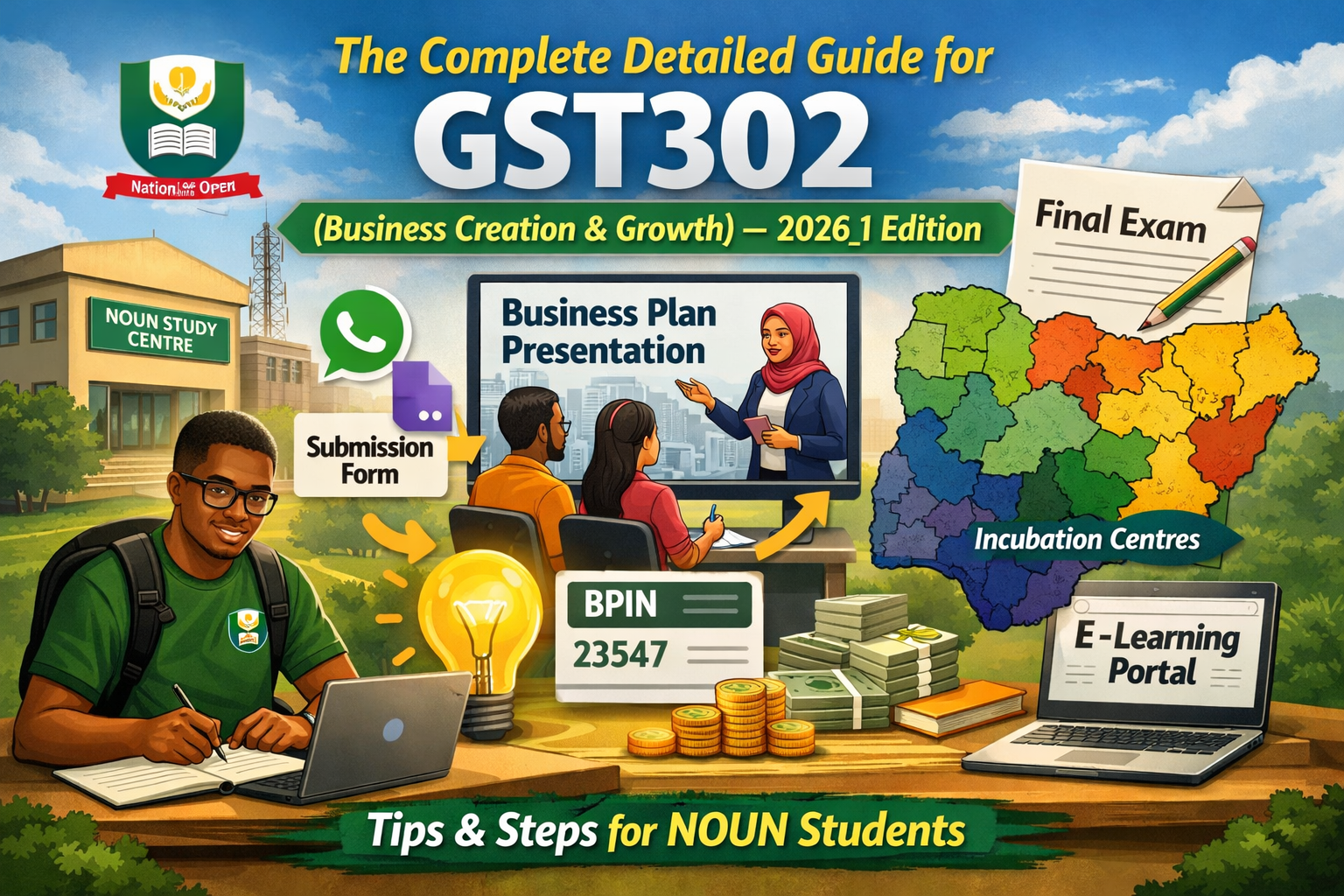
GST302, which stands for Business Creation & Growth, is a compulsory 2-unit course for all undergraduate students, usually taken in 300 level, second semester. However, unlike most courses, GST302 does not include Tutor Marked Assignments (TMA). Instead, it focuses on building a business idea, presenting it, and then writing a final examination.
The journey begins with your course registration. You need to make sure that GST302 is registered both as a course and as an examination. This may seem like a small step, but missing it can lead to complications later on, so it’s important to confirm everything before submitting your registration.
As the semester progresses, a Google Form link will be released, and this is where your real work begins. You’ll be required to submit your personal details along with your business idea. To make things easier for you, here is the official submission link for the 2026_1 session:
In this form, you’ll provide details such as your name, matric number, study centre, phone number, NOUN email address, and most importantly, your business idea.
At this stage, many students begin to overthink things, especially when it comes to choosing a business idea. The truth is, your idea doesn’t have to be overly complex—it just needs to solve a real problem.
For example, instead of choosing a generic name like “Blessed Ventures”, you can go for something more meaningful like “GreenFresh Farms” if it’s agriculture-based, or “QuickFix Tech Services” if it’s related to repairs or tech solutions. A good name should reflect what your business actually does.
When identifying a societal problem, avoid vague statements. Instead of saying “People are suffering”, be specific. You can say “Poor waste disposal in urban areas” or “Limited access to affordable farm produce.” This makes your idea clearer and more impactful.
Your proposed solution is where you explain how your business will solve that problem. For instance, if your focus is waste management, your solution could involve creating a mobile platform that connects households with waste collectors for easy pickup and recycling. If it’s electricity-related, you might propose affordable solar solutions for small businesses.
Another area where students often get confused is identifying their incubation centre. This is actually based on your geopolitical zone in Nigeria. For example, students in Lagos, Ogun, Oyo, Osun, Ondo, and Ekiti fall under the South West zone. Other regions like South East, South South, North Central, North East, and North West also have their respective states, and your state determines your zone.
After submitting your form, the next step is to stay updated. You’ll need to join your zone’s WhatsApp or Telegram group because that’s where updates will be shared. An update sheet will be posted there for you to confirm whether your submission has been accepted.
If your submission is approved, you’ll receive a BPIN (Business Plan Identification Number). This is very important because it confirms that your idea has been accepted. If it’s rejected, the reason will be provided, and you’ll need to correct it and resubmit.
Once you’ve gotten your BPIN, the next stage is creating your PowerPoint presentation. This is where you develop your business idea into a proper business plan. To guide you, here is a ready-made PowerPoint template you can use:
For example, if your business is GreenFresh Farms, your slides should clearly explain what you produce, who your target customers are, how you plan to distribute your products, and how you intend to make profit.
After creating your slides, you’ll submit them on the e-learning portal and prepare for the defence stage. Depending on your zone, this could either be a physical presentation at your study centre or an online defence. During this stage, you’ll present your idea and answer questions about it.
Your presentation carries 60 marks, which serves as your continuous assessment score for the course. After that, you’ll also write the final examination, which carries 40 marks. Together, both determine your final result.
In the end, GST302 is more practical than theoretical. It’s about solving real problems with real ideas. Once you understand the process and follow each step carefully, it becomes very easy to navigate.
If you need help with your PowerPoint creation, structuring your business idea, or preparing for your presentation, you can reach out directly here:
By now, you should have a clear and complete understanding of how GST302 works and what you need to do to succeed.

Share your thoughts about this post